
Robert Moffatt Presents
Exceptional San Francisco Home
$3,015,000
Property Details
Bedrooms
4
Bathrooms
2.5
Square Feet
2,899 sq ft
Neighborhood
Central Richmond
Grand-Scale Edwardian Near Golden Gate Park
Property Tour
3D Virtual Tour
House History
754 30th Avenue
In the prosperous period between World Wars, San Francisco's population boomed and the city grew westward from its downtown core. Numerous houses and all the trappings of complete communities, including small business districts, churches, and schools, sprang up in progression as the city grew into the Western Addition, then the Inner Richmond and Sunset Districts, and eventually the Outer Richmond and Sunset Districts. At 30th Avenue, in the Outer Richmond, the subject house was constructed on what were originally vacant expanses of sand dunes stretching to Ocean Beach. During the 1920s, the dunes were quickly being re-imagined into densely-built neighborhood blocks, with nearby commercial corridors on Balboa Street and Geary Boulevard, to serve them. George Washington High school opened in 1936, to accommodate a growing population of families with school-age children.
The house at 754 30th Avenue was built in 1927 by contractor P.J. Feerick, who lived nearby on 35th Avenue. Feerick was a speculative builder, meaning he purchased vacant lots, developed them with cookie-cutter residential buildings, and then sold them for a profit. He built numerous speculative residences throughout the Richmond District; probably including all five of the identical-looking houses to the south of 754 30th Avenue and a known cluster on the 700 block of 32nd Avenue, which are all fairly identical to the subject house. Feerick partnered with architect Andrew H. Knoll, who probably provided a single set of plans that Feerick simply repeated at each of the properties he developed, flipping the floor plan or changing the facade materials or ornamentation for variety. Knoll's portfolio also includes a striking Art Deco motion picture studio and film lab at 125 Hyde Street and the Mission Revival style St. Nicholas Catholic Church in Los Altos.
The first known owners of the house at 754 30th Avenue were Arthur J. and Agnes E. Oliver, who were in residence by 1930. The federal census of that year shows that Arthur was born in Northern Ireland in 1874. He immigrated to the United States in 1892 and was an accountant with his own practice. He married Agnes in 1901. She was born in California in 1894. The couple did not have any children and, in 1930, they employed Anna E. Moore as a live-in household servant; an indication of some affluence during the years of the Great Depression.
The Olivers owned the house until 1938, then sold it to Dan D. and Estelle C. Oglove. Dan was born in Milwaukee, Wisconsin in 1907 and worked as an automobile salesman. Estelle was born in California in 1910 and the couple had two young sons, Thornton and Warren. The Ogloves lived at 754 30th Avenue through 1950, when they shared the house with the family of Dan’s sister, Jessie Malofski. Morey and Jessie Malofski and their three children – Harvey, Gail, and Susan – increased the household to nine. Morey Malofski was born in Russia in 1906 and was employed as a salesman for a home construction and improvement company.
In 1957, the house was purchased by Max Fisherow, who appears to have been president of the Max Fisherow Corporation and, later, a partner in the company of Fisherow & Wahr, Inc., both of which were in the business of importing food. In 1960, Fisherow sold the property to Robert G. and Emma Lee. Robert was a civil engineer who worked for the San Francisco Department of Public Works, involved with Muni and the Water Department, before becoming principal civil engineer for the San Francisco International Airport in 1968. In 1974, he was promoted to the airport’s Deputy Director of Planning and Development. The Lee family continue to own the property today.
754 30th Avenue, late 1930s (left) and 1956 (right).
(San Francisco Assessor’s Photograph Collection, San Francisco Public Library)
The house at 754 30th Avenue is a two-story over raised basement, Mediterranean Revival style house. The Mediterranean Revival style was extremely popular in San Francisco during the 1920s. Following World War I, American soldiers brought home memories of the picturesque European architecture of France, Spain, and Italy, which was soon translated into domestic residential designs. The Mediterranean Revival style fit nicely with California's Mediterranean environs and lent itself well to efficient building due to its affordable and quickly-applied stucco cladding and the wide availability of plaster ornament that could be applied to decorate facades.
Those facades exhibited organization common to urban San Francisco houses; a basement level garage, entry steps to one side that lead to an entrance that is elevated above the street, and distinctive windows on the upper stories. At 754 30th Avenue, the garage entrance is recessed and features a paneled roll-up door with a tradesman's entrance to one side. This allowed household help to enter the basement and backyard of the property without using the formal front entry. The raised basement level is clad with brick, defining it from the stucco-clad stories above. At the right, terrazzo stairs ascend to the primary entrance at the first story, within a vestibule with a tall arched opening. The arch is crowned by plaster ornamentation featuring a large shield cartouche, urn shaped arctoeria, wide flat frieze and pendant moldings embossed with guilloche and tablet flower patterns, and pine cone or pineapple corbels.
The upper facade is dominated by a wide angled bay window that spans both stories. The windows, which originally had ornate transom sashes, are surrounded by wood moldings and a stuccoed beltcourse defines the stories. The ornate cornice at the roofline features egg-and-dart and foliate moldings, small scroll modillions, and a red clay tile pent roof.
In the prosperous period between World Wars, San Francisco's population boomed and the city grew westward from its downtown core. Numerous houses and all the trappings of complete communities, including small business districts, churches, and schools, sprang up in progression as the city grew into the Western Addition, then the Inner Richmond and Sunset Districts, and eventually the Outer Richmond and Sunset Districts. At 30th Avenue, in the Outer Richmond, the subject house was constructed on what were originally vacant expanses of sand dunes stretching to Ocean Beach. During the 1920s, the dunes were quickly being re-imagined into densely-built neighborhood blocks, with nearby commercial corridors on Balboa Street and Geary Boulevard, to serve them. George Washington High school opened in 1936, to accommodate a growing population of families with school-age children.
The house at 754 30th Avenue was built in 1927 by contractor P.J. Feerick, who lived nearby on 35th Avenue. Feerick was a speculative builder, meaning he purchased vacant lots, developed them with cookie-cutter residential buildings, and then sold them for a profit. He built numerous speculative residences throughout the Richmond District; probably including all five of the identical-looking houses to the south of 754 30th Avenue and a known cluster on the 700 block of 32nd Avenue, which are all fairly identical to the subject house. Feerick partnered with architect Andrew H. Knoll, who probably provided a single set of plans that Feerick simply repeated at each of the properties he developed, flipping the floor plan or changing the facade materials or ornamentation for variety. Knoll's portfolio also includes a striking Art Deco motion picture studio and film lab at 125 Hyde Street and the Mission Revival style St. Nicholas Catholic Church in Los Altos.
The first known owners of the house at 754 30th Avenue were Arthur J. and Agnes E. Oliver, who were in residence by 1930. The federal census of that year shows that Arthur was born in Northern Ireland in 1874. He immigrated to the United States in 1892 and was an accountant with his own practice. He married Agnes in 1901. She was born in California in 1894. The couple did not have any children and, in 1930, they employed Anna E. Moore as a live-in household servant; an indication of some affluence during the years of the Great Depression.
The Olivers owned the house until 1938, then sold it to Dan D. and Estelle C. Oglove. Dan was born in Milwaukee, Wisconsin in 1907 and worked as an automobile salesman. Estelle was born in California in 1910 and the couple had two young sons, Thornton and Warren. The Ogloves lived at 754 30th Avenue through 1950, when they shared the house with the family of Dan’s sister, Jessie Malofski. Morey and Jessie Malofski and their three children – Harvey, Gail, and Susan – increased the household to nine. Morey Malofski was born in Russia in 1906 and was employed as a salesman for a home construction and improvement company.
In 1957, the house was purchased by Max Fisherow, who appears to have been president of the Max Fisherow Corporation and, later, a partner in the company of Fisherow & Wahr, Inc., both of which were in the business of importing food. In 1960, Fisherow sold the property to Robert G. and Emma Lee. Robert was a civil engineer who worked for the San Francisco Department of Public Works, involved with Muni and the Water Department, before becoming principal civil engineer for the San Francisco International Airport in 1968. In 1974, he was promoted to the airport’s Deputy Director of Planning and Development. The Lee family continue to own the property today.
754 30th Avenue, late 1930s (left) and 1956 (right).
(San Francisco Assessor’s Photograph Collection, San Francisco Public Library)
The house at 754 30th Avenue is a two-story over raised basement, Mediterranean Revival style house. The Mediterranean Revival style was extremely popular in San Francisco during the 1920s. Following World War I, American soldiers brought home memories of the picturesque European architecture of France, Spain, and Italy, which was soon translated into domestic residential designs. The Mediterranean Revival style fit nicely with California's Mediterranean environs and lent itself well to efficient building due to its affordable and quickly-applied stucco cladding and the wide availability of plaster ornament that could be applied to decorate facades.
Those facades exhibited organization common to urban San Francisco houses; a basement level garage, entry steps to one side that lead to an entrance that is elevated above the street, and distinctive windows on the upper stories. At 754 30th Avenue, the garage entrance is recessed and features a paneled roll-up door with a tradesman's entrance to one side. This allowed household help to enter the basement and backyard of the property without using the formal front entry. The raised basement level is clad with brick, defining it from the stucco-clad stories above. At the right, terrazzo stairs ascend to the primary entrance at the first story, within a vestibule with a tall arched opening. The arch is crowned by plaster ornamentation featuring a large shield cartouche, urn shaped arctoeria, wide flat frieze and pendant moldings embossed with guilloche and tablet flower patterns, and pine cone or pineapple corbels.
The upper facade is dominated by a wide angled bay window that spans both stories. The windows, which originally had ornate transom sashes, are surrounded by wood moldings and a stuccoed beltcourse defines the stories. The ornate cornice at the roofline features egg-and-dart and foliate moldings, small scroll modillions, and a red clay tile pent roof.
Floor Plans
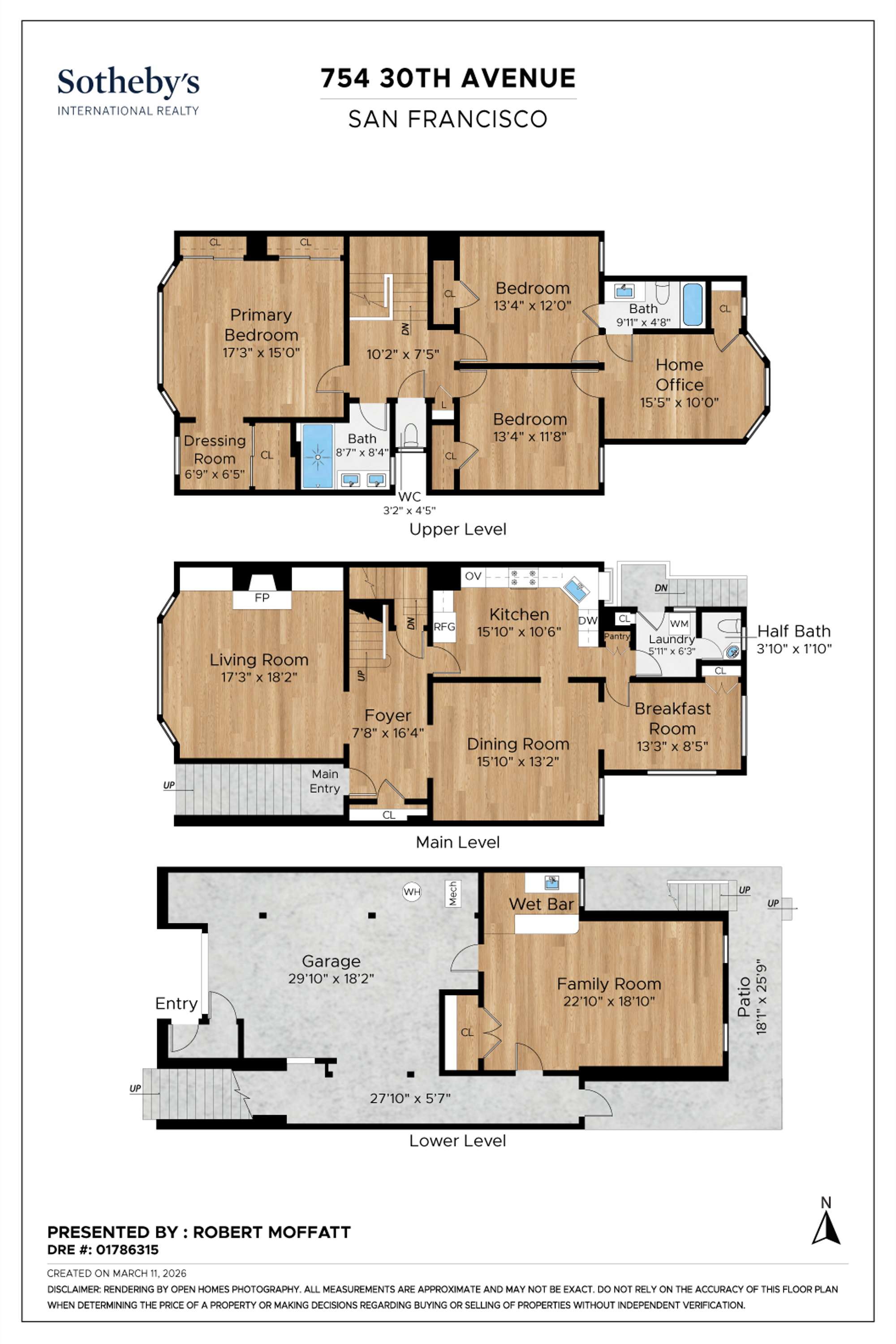
Floor plan
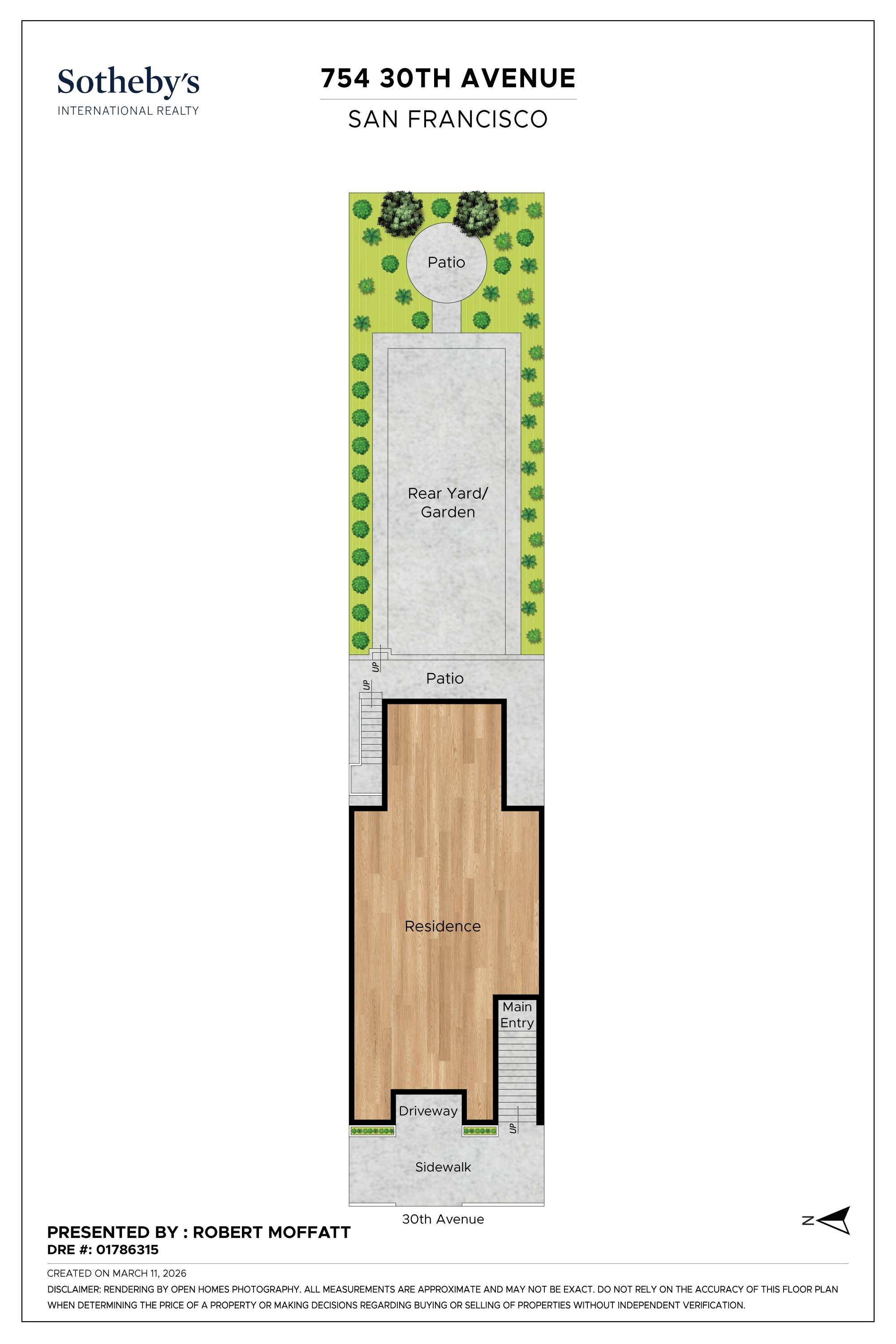
Site plan
Neighborhood
If you are looking for a beautiful neighborhood in San Francisco surrounded by the most popular parks in the Bay Area, the Outer Richmond District is a great place to call home. The community is filled with gorgeous row houses that hug the sloped streets of the Richmond District. With its variety of diverse communities throughout the neighborhood, living in the Richmond District is a true cultural experience.
While the westernmost park of Geary Road can be heavily trafficked, there are plenty of great restaurants and shops to explore on nearby Balboa Street. The Outer Richmond neighborhood is a great place to explore a variety of cuisines around the world, including Egyptian and Vietnamese cuisine.
One of the best features of the Outer Richmond District is it’s within walking distance of Golden Gate Park. The park is home to a wide variety of different activities and festivals, including a free bluegrass festival, as well as the Outside Lands Music Festival. Golden Gate park also features several bike and jogging paths, botanical and Japanese gardens, and since the park is closed to car traffic on Sundays, it provides a peaceful escape from the constant bustle of San Francisco.
The Outer Richmond District is also just a mile away from the scenic Ocean Beach. Known for its high winds and strong currents, Ocean Beach is perfect for surfing, biking along the coast, or simply hanging out. Plus, the beach is dog-friendly and as long as your pooch is well-trained, they can enjoy the beach off leash!
Outer Richmond District residents can explore one of the Bay Area’s most popular tourist attractions found at Sutro Baths. What originally began as a bathhouse in the late 19th Century, Sutro Baths suffered through a variety of economic hardships and ultimately succumbed to a fire in the mid-60s.
After a day of exploring the ruins, most tourists and locals enjoy a fantastic meal with unrivaled ocean views at the Cliff House, which is another amazing Bay Area landmark. The Cliff House has been dazzling its guests with their amazing fare for over 150 years, and if you live in the Outer Richmond District, this restaurant can be enjoyed any time of the week.
While the westernmost park of Geary Road can be heavily trafficked, there are plenty of great restaurants and shops to explore on nearby Balboa Street. The Outer Richmond neighborhood is a great place to explore a variety of cuisines around the world, including Egyptian and Vietnamese cuisine.
One of the best features of the Outer Richmond District is it’s within walking distance of Golden Gate Park. The park is home to a wide variety of different activities and festivals, including a free bluegrass festival, as well as the Outside Lands Music Festival. Golden Gate park also features several bike and jogging paths, botanical and Japanese gardens, and since the park is closed to car traffic on Sundays, it provides a peaceful escape from the constant bustle of San Francisco.
The Outer Richmond District is also just a mile away from the scenic Ocean Beach. Known for its high winds and strong currents, Ocean Beach is perfect for surfing, biking along the coast, or simply hanging out. Plus, the beach is dog-friendly and as long as your pooch is well-trained, they can enjoy the beach off leash!
Outer Richmond District residents can explore one of the Bay Area’s most popular tourist attractions found at Sutro Baths. What originally began as a bathhouse in the late 19th Century, Sutro Baths suffered through a variety of economic hardships and ultimately succumbed to a fire in the mid-60s.
After a day of exploring the ruins, most tourists and locals enjoy a fantastic meal with unrivaled ocean views at the Cliff House, which is another amazing Bay Area landmark. The Cliff House has been dazzling its guests with their amazing fare for over 150 years, and if you live in the Outer Richmond District, this restaurant can be enjoyed any time of the week.
Richmond District
Robert Moffatt
#1 Listing Agent Richmond District
Recent Listings
Schedule
There are no upcoming events.
Get In Touch
Thank you!
Your message has been received. We will reply using one of the contact methods provided in your submission.
Sorry, there was a problem
Your message could not be sent. Please refresh the page and try again in a few minutes, or reach out directly using the agent contact information below.
Robert Moffatt