
Robert Moffatt Presents
Exceptional San Francisco Home
$1,098,000
Day
Aerial
Property Details
Bedrooms
2
Bathrooms
2
Square Feet
1,115 sq ft
Neighborhood
Pacific Heights, San Francisco
Light-Filled Pacific Heights Condo by Alta Plaza Park
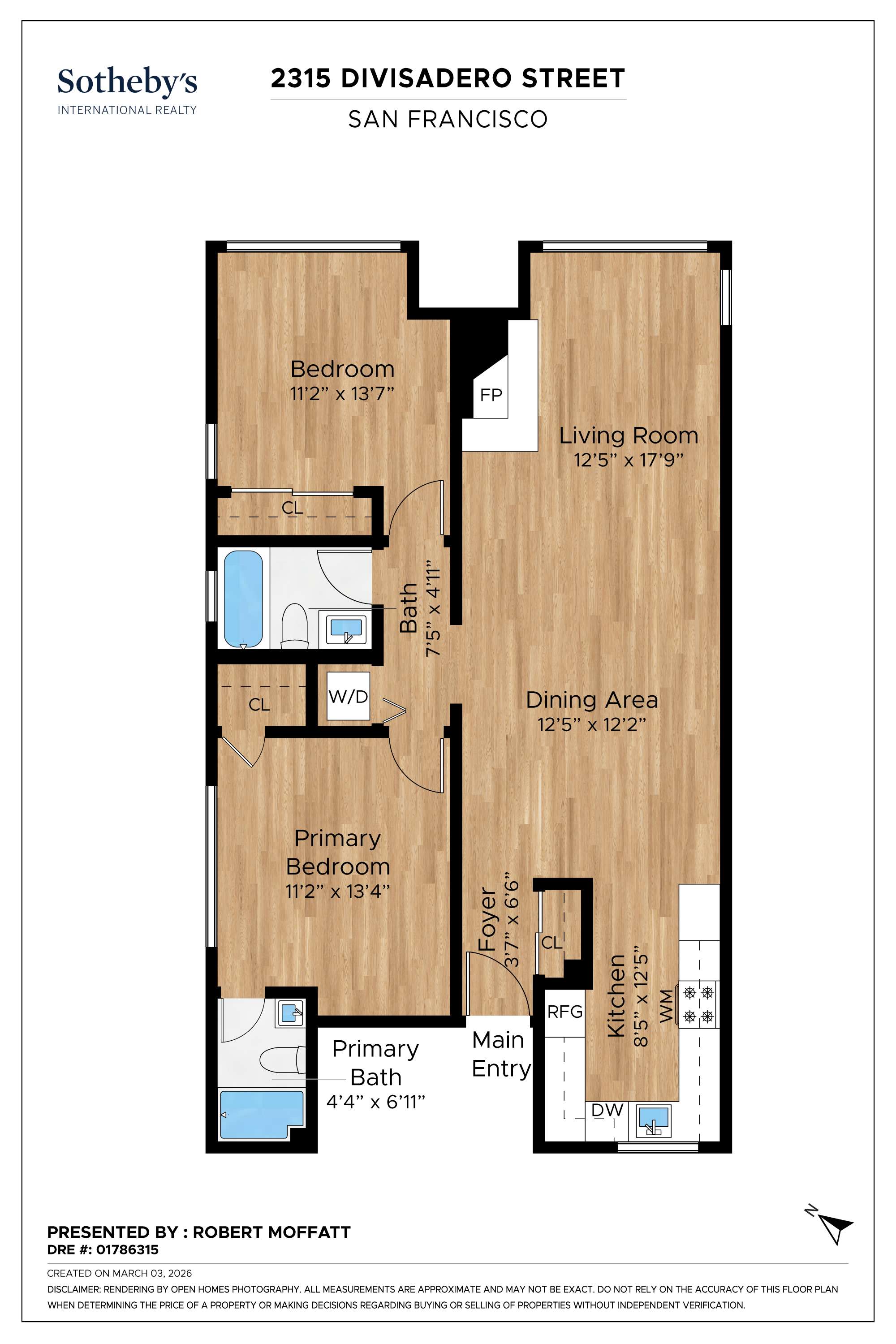
Bright and spacious remodeled two-bedroom, two-bath condominium in the heart of Pacific Heights, just one block from Alta Plaza Park and close to the Presidio, transportation, and exceptional shopping and dining. This inviting home features a beautifully updated kitchen with granite countertops and maple cabinetry, opening to a comfortable living and dining area centered around a charming wood-burning fireplace with a sleek granite hearth. Double-pane windows and cherry wood floors add warmth and comfort throughout. Both bathrooms have been tastefully updated with marble floors and modern fixtures. Additional highlights include an in-unit laundry closet, extra storage, and one deeded parking space. Located in a well-maintained contemporary nine-unit elevator building with updated common areas, this residence offers the perfect combination of style, convenience, and location in one of San Francisco's most desirable neighborhoods.
House History
2315 Divisadero Street
Pacific Heights
The condominium building at 2315 Divisadero Street is located in San Francisco's Pacific Heights neighborhood, just a block from Alta Plaza; one of the area's urban hilltop oases. Pacific Heights became part of San Francisco in the late 1850s after the City annexed the Western Addition and gave land ownership rights to squatters who had been living in the area after the Gold Rush. Between the 1850s and the 1870s, the Western Addition was sparsely developed with a handful of dairy farms and several large weekend retreats owned by prominent businessmen. The rest of the neighborhood consisted of sand dunes and chaparral.
From the 1870s to the turn of the century, Pacific Heights developed into a prestigious suburb for San Francisco's affluent citizens. Streets were graded and cable car lines extended westward, putting Pacific Heights within easy commuting distance of downtown and making theaters, department stores, and other downtown entertainment accessible. Good views increased the attraction for San Francisco’s wealthy families, and working-class residents were eventually squeezed out of the neighborhood.
In addition to its convenient transportation lines, Pacific Heights was also graced with public parks with fantastic views, like Alta Plaza and Lafayette Park. In 1906, downtown San Francisco was devastated by earthquake and fire. Pacific Heights was largely unaffected, but the neighborhood was inundated by refugees. Temporary camps were set up to shelter them in the parks and eventually, many refugees settled in Pacific Heights rather than returning to their decimated neighborhoods. In many cases, Victorian-era row houses were subdivided and converted into multi-family dwellings.
The desirability of a Pacific Heights address continued into the 1910s and 1920s, spurring demolition of many of the Victorian-era mansions and making way for apartment blocks. The Great Depression halted the construction of large apartment buildings, but increased demand for the more affordable and efficient housing within them. During World War II, the population of the city dramatically increased with an influx of war workers, also needing housing. Pacific Heights progressively evolved from a single-family residential enclave to a high-density urban neighborhood.
Only in the 1970s did grassroots preservation efforts strengthen in response to Urban Renewal programs that razed the nearby Japantown and Fillmore neighborhoods. Loss of the old Victorian tapered off in Pacific Heights and they became valued for restoration. Thus, Pacific Heights retains its dignified history mixed with a sense of energetic urban progress and is considered on of the most fashionable and iconic neighborhoods in San Francisco.
2135 Divisadero Street
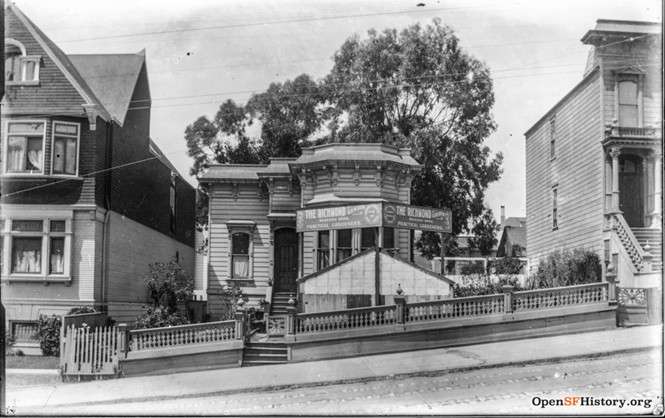
Prior to the current building, the property at 2135 Divisadero Street featured a modest, one-story house. A 1904 photograph shows that it was an Italianate style cottage, probably built in the 1880s or 1890s, when that style was popular within the Victorian aesthetic. The house was owned by the Bouchou family, who operated a nursery on the property. A large sign advertising The Richmond Gardens and a greenhouse were placed prominently at the front of the lot, while the rest of the parcel was filled with plants. There was also a garage at the rear of the lot, large enough for three cars; likely built after the turn-of-the-century as private automobile ownership became common.
By 1932, the house appears to have been divided into apartments, as would have been typical during the Depression, when homeowners took in renters to keep them afloat and renters looked for less and less expensive lodgings. That trend continued when the house was torn down and replaced with the current multi-unit building in 1962.
Apartments in the modern new building were immediately listed for rent in the San Francisco Examiner. Listings described 2 bedroom units for $210-$235 a month in rent, or one-bedroom units for $160. Apartments had 1.5 or 2 baths, electric kitchens with dishwashers, balconies, fireplaces, and wall-to-wall carpeting and drapes. The building had an elevator, garage spaces, and a sundeck.
In the Spring of 1980, the building appears to have been converted to condominiums. Single apartments offered for monthly rental prices in newspaper classified ads suddenly turned into multiple units being offered for immediate occupancy and went for $129,500 to $229,000.
Style
The building at 2315 Divisadero Street is an example of Midcentury Modern architecture. The style emerged in the decades following World War II and was influenced by the sleek and globally popular International style. However, Midcentury Modern aesthetics were more modest and casual, especially when applied to urban residential buildings. In San Francisco, particularly, and as at 2315 Divisadero Street, the style was applied to a common row house form that had existed in San Francisco since the Victorian era. It included a street-level garage, entry to one side, and one or more bay windows dominating the upper stories.
The Midcentury Modern style, at its most expressive, might include distinctive features like cantilevered overhangs, projecting eaves, canted windows, projecting boxes that en‐frame the upper stories, stucco siding, the use of bright or contrasting colors, spandrel glass, large expanses of windows, flat or shed roof forms, stacked brick veneer, asymmetrical facades, and occasionally vertical wood siding. Being strictly modern, the style never made historical references to architecture of the past.
At 2315 Divisadero Street, the Midcentury Modern style is expressed in clean lines and rectilinear patterning; a series of boxes and rectangles from the ground to the roofline. Two square-paneled wood garage doors, in square openings, provide entrance to the raised-basement level garage space, while a square opening to the right leads to an entry vestibule. The basement level of the building is clad with stacked bond, rough textured, Roman brick that creates a strong grid pattern. The upper stories are clad with characteristic smooth stucco, which is scored to create horizontal bands. Two boxy bay windows rise three stories and are fenestrated with horizontal rectangular window openings fitted with symmetrically divided sliding sashes. Prominent window trim represents the characteristic en-framing elements that emphasize the repeated rectangular window pattern. The roofline is flat and adorned only with a simple stucco coping.
Pictured: The Italianate cottage that stood prior to the current condo building at 2315 Divisadero, 1904.
Pacific Heights
The condominium building at 2315 Divisadero Street is located in San Francisco's Pacific Heights neighborhood, just a block from Alta Plaza; one of the area's urban hilltop oases. Pacific Heights became part of San Francisco in the late 1850s after the City annexed the Western Addition and gave land ownership rights to squatters who had been living in the area after the Gold Rush. Between the 1850s and the 1870s, the Western Addition was sparsely developed with a handful of dairy farms and several large weekend retreats owned by prominent businessmen. The rest of the neighborhood consisted of sand dunes and chaparral.
From the 1870s to the turn of the century, Pacific Heights developed into a prestigious suburb for San Francisco's affluent citizens. Streets were graded and cable car lines extended westward, putting Pacific Heights within easy commuting distance of downtown and making theaters, department stores, and other downtown entertainment accessible. Good views increased the attraction for San Francisco’s wealthy families, and working-class residents were eventually squeezed out of the neighborhood.
In addition to its convenient transportation lines, Pacific Heights was also graced with public parks with fantastic views, like Alta Plaza and Lafayette Park. In 1906, downtown San Francisco was devastated by earthquake and fire. Pacific Heights was largely unaffected, but the neighborhood was inundated by refugees. Temporary camps were set up to shelter them in the parks and eventually, many refugees settled in Pacific Heights rather than returning to their decimated neighborhoods. In many cases, Victorian-era row houses were subdivided and converted into multi-family dwellings.
The desirability of a Pacific Heights address continued into the 1910s and 1920s, spurring demolition of many of the Victorian-era mansions and making way for apartment blocks. The Great Depression halted the construction of large apartment buildings, but increased demand for the more affordable and efficient housing within them. During World War II, the population of the city dramatically increased with an influx of war workers, also needing housing. Pacific Heights progressively evolved from a single-family residential enclave to a high-density urban neighborhood.
Only in the 1970s did grassroots preservation efforts strengthen in response to Urban Renewal programs that razed the nearby Japantown and Fillmore neighborhoods. Loss of the old Victorian tapered off in Pacific Heights and they became valued for restoration. Thus, Pacific Heights retains its dignified history mixed with a sense of energetic urban progress and is considered on of the most fashionable and iconic neighborhoods in San Francisco.
2135 Divisadero Street
Prior to the current building, the property at 2135 Divisadero Street featured a modest, one-story house. A 1904 photograph shows that it was an Italianate style cottage, probably built in the 1880s or 1890s, when that style was popular within the Victorian aesthetic. The house was owned by the Bouchou family, who operated a nursery on the property. A large sign advertising The Richmond Gardens and a greenhouse were placed prominently at the front of the lot, while the rest of the parcel was filled with plants. There was also a garage at the rear of the lot, large enough for three cars; likely built after the turn-of-the-century as private automobile ownership became common.
By 1932, the house appears to have been divided into apartments, as would have been typical during the Depression, when homeowners took in renters to keep them afloat and renters looked for less and less expensive lodgings. That trend continued when the house was torn down and replaced with the current multi-unit building in 1962.
Apartments in the modern new building were immediately listed for rent in the San Francisco Examiner. Listings described 2 bedroom units for $210-$235 a month in rent, or one-bedroom units for $160. Apartments had 1.5 or 2 baths, electric kitchens with dishwashers, balconies, fireplaces, and wall-to-wall carpeting and drapes. The building had an elevator, garage spaces, and a sundeck.
In the Spring of 1980, the building appears to have been converted to condominiums. Single apartments offered for monthly rental prices in newspaper classified ads suddenly turned into multiple units being offered for immediate occupancy and went for $129,500 to $229,000.
Style
The building at 2315 Divisadero Street is an example of Midcentury Modern architecture. The style emerged in the decades following World War II and was influenced by the sleek and globally popular International style. However, Midcentury Modern aesthetics were more modest and casual, especially when applied to urban residential buildings. In San Francisco, particularly, and as at 2315 Divisadero Street, the style was applied to a common row house form that had existed in San Francisco since the Victorian era. It included a street-level garage, entry to one side, and one or more bay windows dominating the upper stories.
The Midcentury Modern style, at its most expressive, might include distinctive features like cantilevered overhangs, projecting eaves, canted windows, projecting boxes that en‐frame the upper stories, stucco siding, the use of bright or contrasting colors, spandrel glass, large expanses of windows, flat or shed roof forms, stacked brick veneer, asymmetrical facades, and occasionally vertical wood siding. Being strictly modern, the style never made historical references to architecture of the past.
At 2315 Divisadero Street, the Midcentury Modern style is expressed in clean lines and rectilinear patterning; a series of boxes and rectangles from the ground to the roofline. Two square-paneled wood garage doors, in square openings, provide entrance to the raised-basement level garage space, while a square opening to the right leads to an entry vestibule. The basement level of the building is clad with stacked bond, rough textured, Roman brick that creates a strong grid pattern. The upper stories are clad with characteristic smooth stucco, which is scored to create horizontal bands. Two boxy bay windows rise three stories and are fenestrated with horizontal rectangular window openings fitted with symmetrically divided sliding sashes. Prominent window trim represents the characteristic en-framing elements that emphasize the repeated rectangular window pattern. The roofline is flat and adorned only with a simple stucco coping.
Pictured: The Italianate cottage that stood prior to the current condo building at 2315 Divisadero, 1904.
Property Tour
3D Virtual Tour
Floor Plans
Floor plan
Neighborhood
Living in Pacific Heights provides an opportunity to rub elbows with some of Silicon Valley’s most prominent players. PayPal founder Peter Theil, Oracle CEO Larry Ellison, and Apple designer Jonathan Ive have all made their homes in what is considered one of the most expensive neighborhoods in the United States. Palatial highrise condos and luxurious row houses are the most common types of real estate you will find in Pacific Heights.
Although the Presidio is just a short trip away from Pacific Heights, the neighborhood features two small parks of its own: Lafayette Park and Alta Plaza Park. Lafayette Park offers beautiful grassy hills, a playground, and an off-leash dog park, while Alta Plaza is perched even higher with most of the same amenities.
When Pacific Heights residents are looking for a place to eat, they usually make their way to Fillmore Street. This area is also a great place to enjoy a day of shopping and entertainment.
Locals and tourists are often amazed at the variety of landmarks and attractions you can find in Pacific Heights. Enjoy a guided tour through the Haas-Lilienthal House, San Francisco’s only Victorian House museum open to the public for house tours, or check out the McElroy Octagon House, which serves as both an architectural treasure and a Colonial and Federal Periods Decorative Arts Museum.
Lastly, the southeast corner of the Presidio is less than two miles away, so there is always something fun to explore near the Pacific Heights neighborhood!
Although the Presidio is just a short trip away from Pacific Heights, the neighborhood features two small parks of its own: Lafayette Park and Alta Plaza Park. Lafayette Park offers beautiful grassy hills, a playground, and an off-leash dog park, while Alta Plaza is perched even higher with most of the same amenities.
When Pacific Heights residents are looking for a place to eat, they usually make their way to Fillmore Street. This area is also a great place to enjoy a day of shopping and entertainment.
Locals and tourists are often amazed at the variety of landmarks and attractions you can find in Pacific Heights. Enjoy a guided tour through the Haas-Lilienthal House, San Francisco’s only Victorian House museum open to the public for house tours, or check out the McElroy Octagon House, which serves as both an architectural treasure and a Colonial and Federal Periods Decorative Arts Museum.
Lastly, the southeast corner of the Presidio is less than two miles away, so there is always something fun to explore near the Pacific Heights neighborhood!
Robert Moffatt
#1 Listing Agent Richmond District
Recent Listings
Get In Touch
Thank you!
Your message has been received. We will reply using one of the contact methods provided in your submission.
Sorry, there was a problem
Your message could not be sent. Please refresh the page and try again in a few minutes, or reach out directly using the agent contact information below.
Robert Moffatt